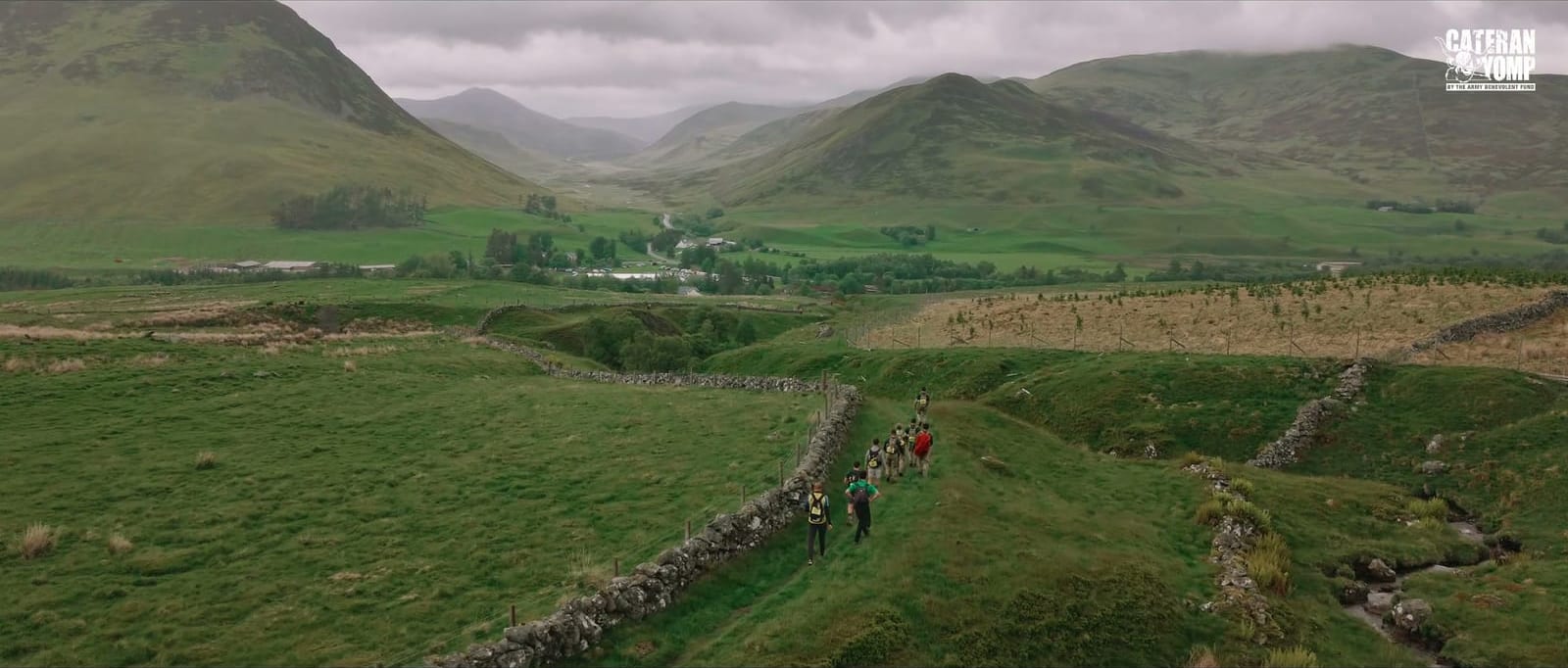
Most event video production in Scotland produces the same film. A drone shot of the venue, a montage of people arriving, three interviews saying it was a great day, upbeat music, a logo. It is competent, everyone nods, and nobody outside the organisation ever watches it twice. Having just filmed the 2026 Cateran Yomp, fifty-four miles across highland Perthshire in twenty-four hours in aid of the Army Benevolent Fund, I want to set out what we do differently and why it produces something people actually finish watching.
The problem with the standard event film
The standard event film fails because it is a record rather than a story. It answers the question “what happened here” for people who already know, and it has nothing to say to anyone else. That is why it lives on a website getting a few dozen views and is quietly forgotten before the next one is commissioned.
An event film earns attention when it has an argument. Not a slogan, an actual question the film is willing to test on camera. Get that right and the film works on people who were never there, which is the whole point, because the audience that matters is next year’s participants, next year’s donors and the people deciding whether this event is worth their weekend.
Finding the question before you find the shots
On the Cateran Yomp, the question arrived on the start line. Someone from the Army Benevolent Fund said that the event makes and breaks people, and that standing there looking at the participants you can never tell who is going to walk all fifty-four miles.
That is not a nice line for a highlights reel. It is an experiment, and it gave the film its shape. If you cannot tell who will finish, then the film’s job is to find out what the difference is.
So we built the whole production around testing one word. On the Friday, before anyone had walked a step, we asked participants what grit meant and what they thought the night would do to them. They gave us confident, articulate, largely untested answers. Then we filmed the event itself, through the dark, and back to the finish line on Sunday morning, and let the footage judge the claims.
One participant told us on Friday that at three in the morning he would definitely be in some pain and probably some regret. The film plays his own prediction back over footage of the night. Nothing needs to be said over the top of that. The structure does the work.
Film the cost, not the effort
The visual grammar of an endurance event is easy to get wrong. The instinct is to shoot effort: people striding out, poles working, determined faces. It looks energetic and it says nothing, because effort is what everybody expects.
What reads on camera is cost. The shot is not the moment someone stops, it is the moment they start again. Hands on knees, then the head lifts, then the body moves. A set jaw and interior eyes. The slow blink of somebody who has not slept. Hold those two seconds longer than feels comfortable in the edit and the audience understands what the event actually asks of people.
The same applies to sound. In the night section of the Yomp film, the mix is mostly wind, breathing and the rhythm of walking poles, with long gaps between voices. Silence is not dead air in a film like this. It is the thing that makes the next voice land.
It is also worth filming the people watching. A volunteer marshal standing at a checkpoint at two in the morning, watching walkers come through, often shows you more about what is happening than the walkers themselves.
The interview that changes the film
Somewhere in most event shoots there is one interview that reframes everything else, and you will not get it from a prepared spokesperson. On the Yomp it came from a soldier on the trail, and it was sharp enough that we built a second, shorter film entirely around it.
He pointed out that we had asked him about grit at mile seven and that mile seven was a poor place to ask, because at mile seven everybody is comfortable. The weather was warm, nobody had blisters, and what sounded like grit was really just noise: people announcing what they were going to do and how fast they were going to do it. Grit, he said, is quiet. It is what is left forty miles later when the blisters have formed and popped and formed again on the raw skin, and there is nothing to do but put your head down and keep going until the job is done.
That interview retroactively re-graded everything the film had already shown. It is the reason both films work, and we would never have got it from a briefing document. You get it by being on the trail at the point where people have stopped performing.
Two films, not one
Almost every event commission should deliver more than one cut, because the audiences are different.
The long film, at a little over nine minutes, is for the organisation, its supporters and the people considering taking part. It has room for structure, for the Friday claims and the night that tests them, and it ends with the event’s ambassador, a beneficiary of the charity, giving the film its last word.
The short film runs two minutes and rests on a single clear argument about why events like this matter to the Army. It travels much further on social media, and because it does not assume you were there it works on a complete stranger.
Planning for both at the shoot stage costs almost nothing. Trying to retrofit a short cut from footage gathered only with a long film in mind is much harder.
What this means if you are commissioning an event film
Decide what you want the film to prove, not what you want it to show. Give the crew access to the difficult parts, not just the ceremonial ones, because the ceremony is the least interesting footage available. Accept that the most valuable interview will probably be unplanned. And ask for more than one cut, aimed at more than one audience.
Above all, be willing to let the film ask a real question. The Cateran Yomp film works because it was prepared to test whether the thing everybody says about the event is actually true. It turns out it is, but the film had to earn that rather than assert it.
If you run an event in Scotland and want a film that does more than record it, our sport and adventure filmmaking service covers this kind of work, and the Mark Beaumont Hebridean Way case study shows the same approach applied to a single athlete’s endurance attempt.
Frequently asked questions
How many crew do you need for an event film?
Fewer than most people expect, and the number matters less than where they are. A small, self-sufficient crew that can stay out overnight, move quickly between points on a fifty-four mile route and work without support is worth more than a larger team that needs managing. The Cateran Yomp was covered this way, including the night section.
Can you film through the night?
Yes, and on endurance events the night is usually where the film is. It needs planning: lighting that does not intrude on participants, kit that keeps working in the cold and wet, and a crew prepared to be awake and useful at three in the morning. It is also, reliably, where people stop performing for the camera.
What deliverables should an event film include?
At minimum a main film for the organisation’s own channels and a short cut for social media, ideally planned together before the shoot. Depending on the event, versions for sponsors, funders or next year’s recruitment can be cut from the same material at little extra cost, provided the requirement is known in advance.